














Office Storage Capacity Guide: Filing, Cupboards and Lockers
Office storage should be chosen around the items it must hold, the people who need access and the space available. A cabinet that looks large externally may offer less usable capacity than expected, while the wrong internal layout can make files, equipment or personal belongings difficult to organise.
This office storage capacity guide explains how to compare filing cabinets, cupboards, lockers, shelving and pedestals before ordering.
Audit what needs to be stored
Begin with an inventory. Group items by type, quantity, size and frequency of use. Separate active documents from archives, personal belongings from shared supplies and valuable equipment from items that can remain on open shelves.
Measure bulky or unusually shaped items. Count existing folders, boxes or trays and allow sensible room for growth rather than filling every unit on the day it arrives. If old material can be securely disposed of or digitised, complete that review before buying more furniture.
Capacity is more than external dimensions
External width, depth and height determine whether a unit fits the room. Internal shelf dimensions, drawer depth and door opening determine what it can actually hold. Check both sets of measurements on the product page.
Adjustable shelves can improve flexibility, but confirm the number supplied and the spacing available. Also check the unit's load guidance and distribute heavy items appropriately. Do not assume that every shelf or drawer is intended for dense archive storage.
When to choose filing cabinets
Filing cabinets are designed for organised document storage. Before ordering, establish whether the office uses A4 suspension files, foolscap files, lateral filing or another system. The cabinet and file format must be compatible.
Compare two-, three- and four-drawer models by usable filing capacity, not just height. Check whether the unit is lockable and whether an anti-tilt mechanism is included. Position cabinets so drawers can open without blocking an important route.
When office cupboards work better
Office cupboards suit mixed supplies, boxed files, equipment and items that benefit from doors. They can provide flexible capacity where shelf positions can be adjusted.
Measure the tallest and deepest items and account for hinges, door thickness and internal fittings. In narrow spaces, check the clearance needed to open hinged doors. Lockable cupboards may be useful where access must be controlled, but the lock type and security level should be assessed against the items stored.
Use lockers for personal or allocated storage
Office lockers are useful for staff belongings, schools, changing areas and shared workplaces. Capacity depends on the number and size of compartments. A unit with many small doors is not equivalent to one with fewer full-height compartments.
Decide what users need to store: a bag, coat, helmet, laptop or work equipment may require different compartment proportions. Review lock options, ventilation, floor fixing or wall restraint requirements and how keys or codes will be managed.
Open shelving and bookcases
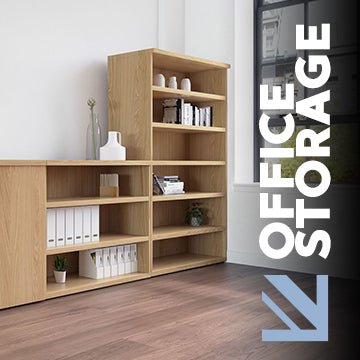
Shelving units and bookcases keep frequently used or display items visible. They can be efficient where security and visual concealment are not priorities.
Check shelf depth, adjustable positions and load guidance. Avoid placing heavy materials on unsuitable shelves or allowing high units to become unstable. Follow the manufacturer's positioning and fixing instructions.
Pedestals for workstation storage
Office pedestals keep personal items and active files near the user. Mobile models can provide flexibility, while fixed-height versions may be designed to sit beside or support particular desk ranges.
Measure the space beneath the desk and allow room for the user's legs and chair. Confirm whether the drawers are designed for stationery, suspension filing or both, and whether the pedestal locks.
Plan storage access and location
Frequently used items should be easy to reach without disrupting colleagues. Archives and infrequently used stock can normally be positioned away from prime workstation space. Place shared supplies where the intended team can access them, and avoid creating queues or obstructions around one cabinet.
Consider how deliveries, cleaning and future reconfiguration will work. Matching storage ranges can help maintain a consistent appearance and make later additions easier.
Office storage buying checklist
- List and measure everything that must be stored.
- Check internal dimensions, shelf spacing and drawer format.
- Allow capacity for realistic future growth.
- Match filing furniture to the document and suspension-file format.
- Decide who needs access and whether locking is required.
- Measure door and drawer opening clearances.
- Review load guidance and installation instructions.
- Keep frequently used items near their users.
Compare office storage solutions
Explore filing cabinets, cupboards, lockers, shelving and pedestals across our office-storage ranges. If you are planning storage for several departments or sites, request a quote for help comparing quantities and specifications.
Free UK delivery is available across much of the range. Check individual product pages and our delivery information for current lead times and conditions.